


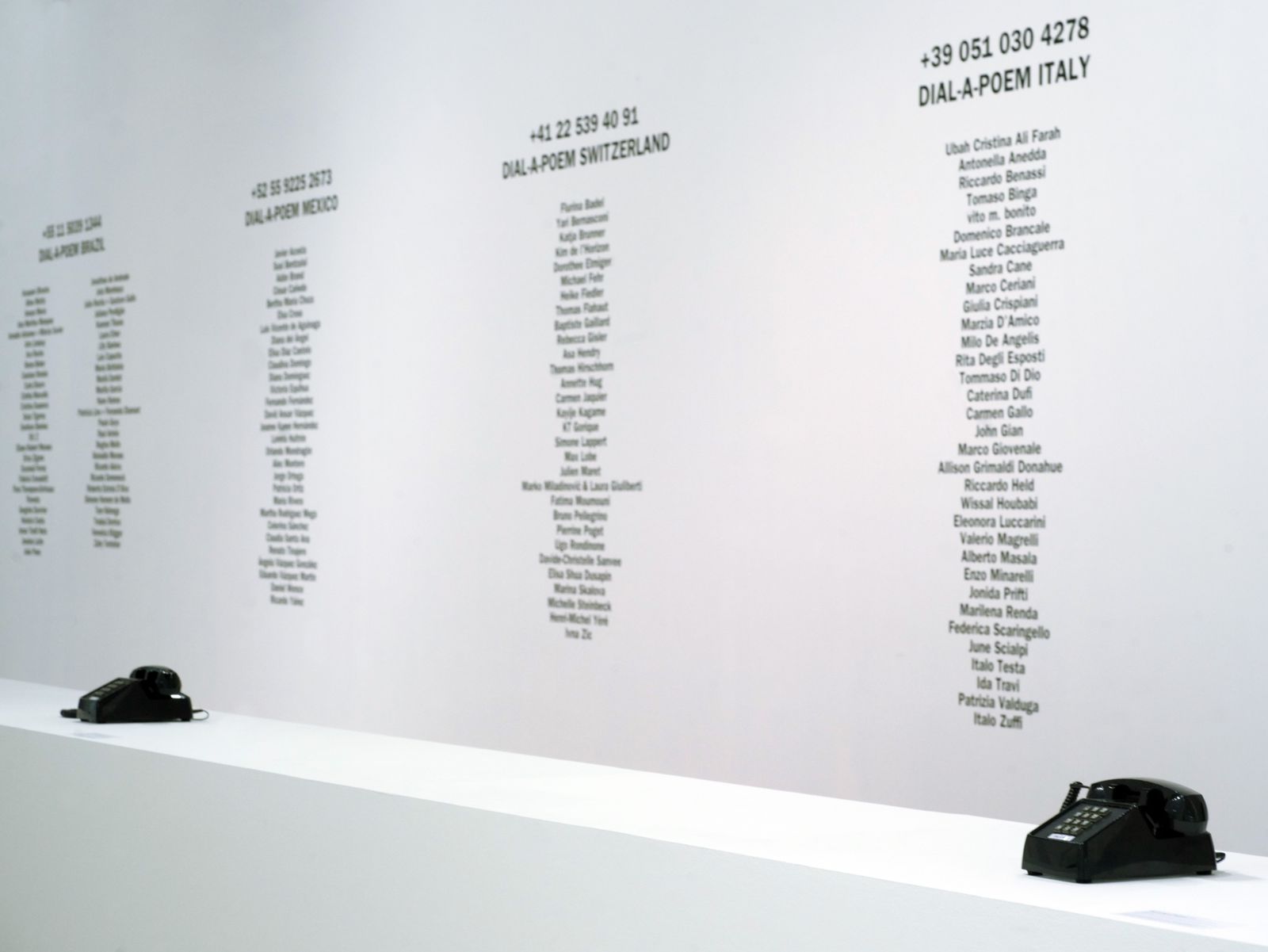
The noises that punctuate a telephone call are often loud, sudden or stark. The high-pitched, sustained beep that comes before a voicemail message; the shrill ringing of rotary phones; the blunt beeping of a mobile phone cutting off. And yet, if a call is made and a connection is maintained, an intimacy is brought out between listener and speaker. Something that’s powerful but delicate; a connection that’s easily severed. In John Giorno’s Dial-A-Poem project (1968), the beeping that precedes his recorded verse set against the spoken work itself captures that close juxtaposition between connection and disconnection. It’s a boundary blurred by how vastly distant the artist, poet and activist’s disembodied voice feels to the listener.
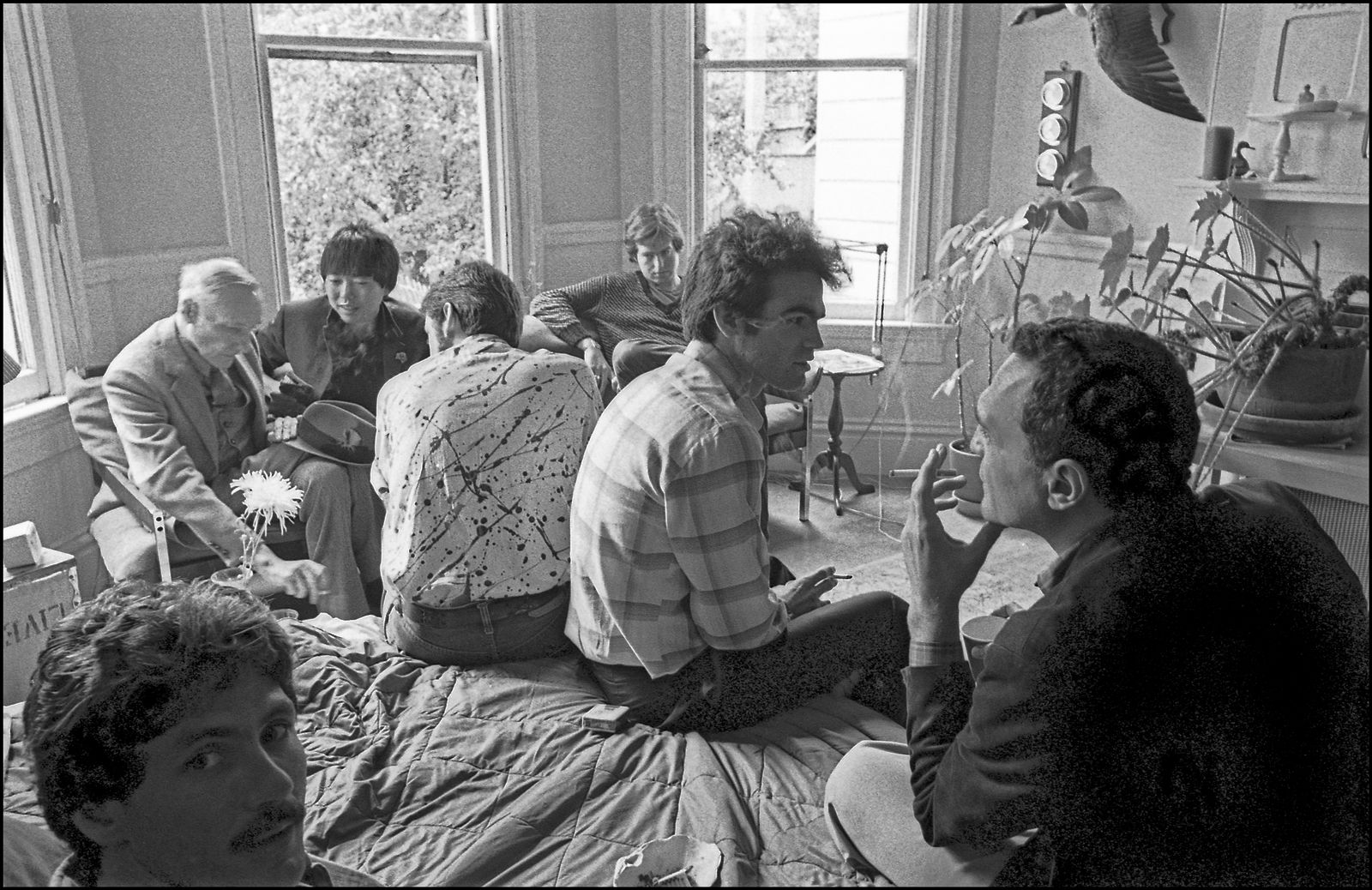
At John Marchant Gallery in Brighton, where the series is displayed, a wall bears a static, projected image of a telephone; the object looms, ominous, as if reaching out from beyond the grave – a sense made especially resonant since so many of Giorno’s poems are about loss and grief. These textual pieces are so often given their power by a rich attention to detail and physicality; in ‘The Death of William Burroughs’, for instance, the poet describes the beat icon lying in his coffin, surrounded by his most loved objects in life: among them, a hat, his favourite gun and a sports jacket that, the poet writes, ‘was the best of his shabby clothes, and smelling sweetly of him’.
The impact of this work comes not just from Giorno’s poetry, but from the presence of the telephone itself; an everyday object that has been able to bring people together for 150 years. It’s no wonder, then, that the device has been imbued with countless shades of significance throughout modern and contemporary art, perhaps most famously Dalí’s otherworldly Lobster Telephone (1936); the Surrealist wrote of endless possibilities for the object in his 1942 autobiography, models defined by colour, artistic referentiality and increasingly bizarre ideas like ‘telephones on a leash which would walk about’.
Since his – and Giorno’s – work, the meanings of the telephone as an artistic symbol have only multiplied, yielding endless ways of exploring that tension between a physical, constant object and the uncertainty that always seems to be waiting on the other end of the line. The 1969 exhibition Art By Telephone at the MCA Chicago saw artists dictating instructions for artworks to the museum’s staff over the phone; the staff themselves would then create the work and, after the show concluded, everything created would be destroyed. Giorno’s poetry, transmitted in the same way, also exists at this point between the possibilities of conversation and collaboration, and animates the fleeting nature of the world that surrounds the phone. In the poem ‘Everyone Gets Lighter’, Giorno places physical space and objects – private jets; a glass of champagne; a ‘vast dome of blue sky’ – in contrast with the human inevitability of disappearing, fading away. With a delicate lilt in his voice, he declares ‘everyone gets / lighter / everyone gets lighter / everyone is light’. We’re connected – to each other, to the world, to the objects that surround us – until we aren’t.
It’s no wonder, then, that more contemporary work using the telephone as its jumping-off point considers this sense of disconnection in the context of a world that’s become more rapid, more technologically advanced; a moment in which connection is everywhere, and yet more transient and uncertain than ever. Christian Marclay’s Telephones (1995) brings together a montage of phones ringing, being answered and then hung up – but the artist and composer waits several minutes before anyone says the word hello. Here, phone calls become dispatches into the void, more like a prayer than anything else. Even as he strings together a complicated web of attempted communication, it never takes the form of a conversation. Instead, Marclay seeming to predict the information overload that would come with the way the phone evolved in the decades after his video. It’s impossible to think about the place of the device in art and culture without being keenly aware of the fact that it now holds the entire world in its increasingly small hardware suite. But Giorno’s poetry – and the static, looming image of an old phone, before all this – speaks to the power of, above anything else, being able to sit for a while and listen.
‘John Giorno: Seven Dial-A-Poems’ runs at John Marchant Gallery until 19 September 2026. Play the poems here: dial-a-poem.org