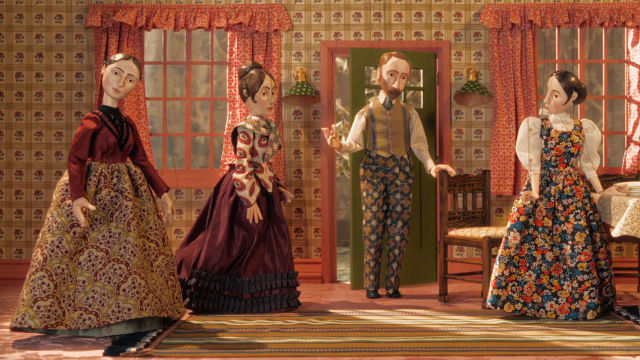
Sicily is a palimpsest of cultures created over three millennia by Greeks, Romans, Byzantines, Arabs, Normans and the Spanish, who invaded in turn and left their mark. The Palazzo Branciforte in Palermo, transformed by Gae Aulenti a decade ago, is a microcosm of this legacy. Archeological finds are displayed in the former stables. A library contains 50,000 books on the history and arts of the island, as well as coins, maiolica and modern bronze sculptures. Colourful Sicilian puppets inhabit a vast stack of wood shelves and the restaurant, located in a cool white room, plays variations on a unique culinary tradition.
The Branciforte family (its name meaning ‘strong claw’) traces its origins back to the court of Charlemagne; by 1600 it had acquired feudal estates all over Sicily and constructed its palace in Palermo, later extending the complex to occupy an entire city block. Two centuries later it ran out of male heirs and a new owner ceded the palace to the senate of Palermo. To relieve the indigent, the senate then installed a second municipal pawnshop – the first having dated back to 1541. There families could deposit their possessions and raise money to pay off debts or, in later years, to emigrate to America. The Monte dei Pegni di Santa Rosalia was dedicated to the patron saint of the city, and would go on to become a valued institution.


In 1848, a wave of revolutions swept over Europe and the Spanish rulers of Sicily were an inviting target. Even though the Branciforte palace was now a resource for the poor, rebels threw a bomb inside, gutting the interior of one wing. Within the smoke-stained shell, a new wooden structure was later constructed – as lofty and labyrinthine as one of Piranesi’s Carceri. Rickety steps ascend to tiers of shelves, which continued to provide space for pawned goods until the enterprise shut down in the 1970s.
The Fondazione Sicilia, funded by the Bank of Sicily, acquired the decrepit relic in 2005 and turned it into a showcase for their collections and educational programs. A documentary film chronicling the five years of restoration shows how ruinous the palace interior had become: the entire building had to be stripped, reinforced and refurbished. Steel beams were inserted to support the upper floors and protect from earthquakes, while experts brushed centuries of dust from moldings and wall paintings, preserving as much as possible of the original fabric.

Gae Aulenti turned 80 as she received this last commission, and she died in 2012 as it was completed. In her prolific five-decade career as an iconoclastic architect and designer, she won fame — and indeed notoriety — for several adaptive reuse projects, notably her transformation of the Gare d’Orsay into a museum of 19th-century French art. There, and in the Museu Nacional d’Art de Catalunya in Barcelona and the Asian Art Museum in San Francisco, her interventions were assertive. Some felt they upstaged the art. But here, in the deftness and the detail, she took her cues from Carlo Scarpa, an architect celebrated for his juxtapositions of old and new wherein each subtle element intensifies the impact of the rest. In his native Venice, the Castelvecchio Museum of Verona, and the Abatellis and Chiaramonte palaces of Palermo, Scarpa’s work reveals itself quietly and slowly, like the cut and stitchwork of a master tailor.


A similar effect can certainly be observed in the palazzo. Its exterior remains unchanged: white stucco walls enlivened by an ochre cornice and window surrounds rise from a rusticated base. But look closely and you will see that the grilles over the windows are no longer purely functional, but double-layered and precise. They are repeated along the galleries that surround the triple-height library; the spiral staircase that links those walkways is concealed by a pale green screen. Gaze upwards, and there’s a bright and energetic ceiling mural by Ignazio Moncada di Paternò, a distant descendant of the Brancifortes. But the atmosphere overall is studious and serene, with books as the star attraction. The marble columns of the stables have been augmented with slender steel ones for added support. A small theatre has gridded walls and ceiling inspired by Aulenti’s Spazio Oberdan auditorium in Milan. But this rebel is no longer throwing bombs; her last work may well be her most refined.
Traditional Sicilian puppets and the gaudy banners that advertised late-night performances in the back streets of the working-class quarters are displayed on the lower shelves of the pawnshop. On my first visit to Palermo in 1966, I attended one such show, presented by Giuseppe Argento and sons, a family enterprise dating back to 1890. Christian knights battled Saracens and fair maidens were rescued from dragons to the cheers and jeers of locals, who brought out chairs from their homes. Small children squatted on the cobbles, equally entranced. Few had television back then, making these shows a highly valuable source of entertainment.

Mimmo Cuticchio and his family continue the tradition in the Opera dei Pupi theatre, which he opened in 1977, a few blocks from the palace. When part of his collection was acquired by the Fondazione Sicilia, it inspired him to reinvigorate the classical repertoire, adding new plots, characters and shows for children. He still provides commentary in Sicilian dialect, but his son, Giacomo, composes music influenced by Philip Glass. Cuticchio is practicing an art that was first recorded in Greece in the fifth century BC – a poplar counterpoint to the dramas of Aeschylus and Euripides. Like him, the Palazzo Branciforte celebrates the multifaceted history and cultures of Sicily, bringing them to life for today’s residents and visitors.
Tours of the Palazzo Branciforte, Palermo, are offered year-round, and the library is open to the public. For more information, visit palazzobranciforte.it