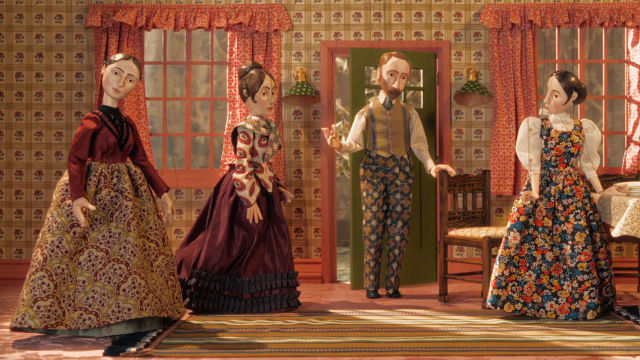
Is folk art having another revival? There are many signs of renewed interest in folk customs and culture today, from the recent Simon Costin exhibition Un/Common People, to the growing popularity over the past few years of menhir-enthusiasts’ society Stone Club, the NeoAncients festival, Weird Walk zine, not to mention the whole host of musicians, storytellers, visual artists and dancing groups (like Boss Morris) exploring these traditions in a modern context. Many of these voices now germinate from new platforms and collectives such as the Ffern Folk Foundation, which supports British folk arts and traditions, Woven Women and Tradfolk. But of course, for centuries before these initiatives, local communities have been enriched by the art and acts of making deeply rooted in their regions’ various old myths and timeless narratives.
Before the advent of mass production, folk art humbly filled ordinary households, covering practical objects with hand-painted decorations that imbued the everyday with beauty and meaning. In Eastern Europe, traditional crafts and industries – ceramics, textiles, basket-weaving and the production of furniture such as chests, tables and cabinets – incorporated folk art as both a means of adornment and a type of communication. According to interior designer Martine Claessens, there was nothing random about these motifs. In the ones sewn on to Romanian textiles, as she puts it: ‘Every stitch is a code. It tells you the story of its creator.’


From the delicate embroidery of prayer suzanis in Uzbekistan to the Ottoman painted tulips that signify the sacred feminine, these motifs often have a symbolic geometry, balance and harmony to them. Both in the cases of Hungary’s matyó and kalocsai floral embroidery and Romania’s panoply of animal and plant motifs, these acts of decoration are firmly rooted in local community life and values. Embroidered or printed folk art on headscarves, dresses and chemises, indeed, were believed to channel a strengthening force into the wearer of the clothes; the same patterns on household objects, meanwhile, are thought to imbue protective energy into a particular trunk, dresser or plate.
In Sussex, beekeeper Karina Czudnochowski’s colourful home and garden huts are modern havens of folkloric ritual painting. No surface is too mundane to receive a blessing from her brush: beehives, cutlery drawers, bookshelves, mirrors. Even the boiler unit is painted lovingly with windmills, flowers, horses and other improvised shapes, from cellular patterns to miniature mandalas. Karina has been painting these delicate motifs since she was a teenager; where they come from she’s not quite sure, but many animals and plants in folk art arise from an ancient world view where symbols are polysemous – that is, they do not possess one singular symbolic significance; rather, meaning is layered and often carries multiple contrasting resonances. For example, in the folk traditions of oral storytelling and art, the bear, the wolf, the horse, the bird and the deer don’t just represent one thing; these animals are signifiers of a complex range of associations linked to a rich history of lore.


Birds can represent freedom, spirituality and the boundary between the earthly and the celestial, but the specific meanings vary widely depending on culture, species and context. The horse, a motif close to Karina’s heart, makes many appearances in other folk cultural contexts too. The horse features in the famous Padstow ‘Obby ‘Oss parade, as well as the Welsh wassailing tradition of the Mari Lwyd, where a horse’s skull is decorated with ribbons and bells as part of a local rhyming contest and folk ritual. Other examples of the equine in these contexts include the Swedish Dala Horse, a wooden carved, painted toy associated with strength, courage, power and grace. Closer to home, meanwhile, there’s the Uffington Horse, a prehistoric chalk figure located in Oxfordshire. This piece of ancient land art, with its simple white outline, holds interpretations ranging from an emblem of freedom to an act of territorial marking. The horses in Karina’s art connect her to the horses of her local terrain in the Ashdown Forest, her neighbouring Sussex landscape (and, incidentally, also the inspiration for Winnie-the-Pooh’s Hundred Acre Wood).


Welsh contemporary folk artist John Abell uses folkloric motifs to write a love letter to the landscape of Wales. Fantastical and apocalyptic, John’s work is built on a close connection to land and the mythology of Cymru. A pantheon of folkloric deities reincarnate in his reimaginings of the Welsh popular print, which share qualities reminiscent of the woodcuts of Welsh artist David Jones (1895–1974). Ceridwen enchantress and keeper of a magical cauldron, Blodeuwedd a mythical woman who was created from flowers by wizards and then transformed and owl, and people’s hero Dr William Price, feature in his monochromatic prints. Cascading waterfalls and lighthouses, all enveloped in flowing, rhythmic lines have a musical quality and dance across his canvases in his latest exhibition at Gallery Ten in Cardiff. Abell’s art conjures an interconnected cosmos of hidden faeries and liberated forest creatures, pulsing with elemental forces.
The motifs that abound in folk embellishment, rather than being labelled as naive, should be regarded as markers of ancient wisdom and cultural depth. A means of fostering a meditative connection with nature, folk art represents the tree trunk of the here and now – though its roots are strong and far-reaching, drawing power from the memory of our ancestors.